Showing posts with label nz birds. Show all posts

Tuesday, 12 August 2025

Kererū


Lately I've been seeing 3 fat KererÅ« aka wood pigeons out in my backyard. We are just about to go into Spring in September so they are no doubt waiting for berries on trees and for my Kowhai tree to bloom as they like to eat the nectar from the flowers. 


It was a bleak late Winter's day in the top photo so I found the above photo online to show whar the bird's colours look like.


This video is a view of my neighbour's shed and plum tree which overhangs my backyard. The bird singing is that of a Bellbird aka Korimako.

Monday, 31 March 2025

Pukeko


I have been meaning to get photos of this mural for ages. It features one of our birds, the Pukeko on the side of a bush shed at the Kumara Junction between Greymouth and Hokitika.


The artist is Rae Eder-Hopkinson. Pukeko is the New Zealand name for the purple Swamphen and it is believed to have come here about a thousand years ago from Australia.


These birds are commonly seen looking for food along the side of ditches, damp areas, creeks etc - they are very pretty in colour. I had to lighten these photos considerably as it was quite overcast.

Linking up with Monday Murals.

Monday, 28 December 2020

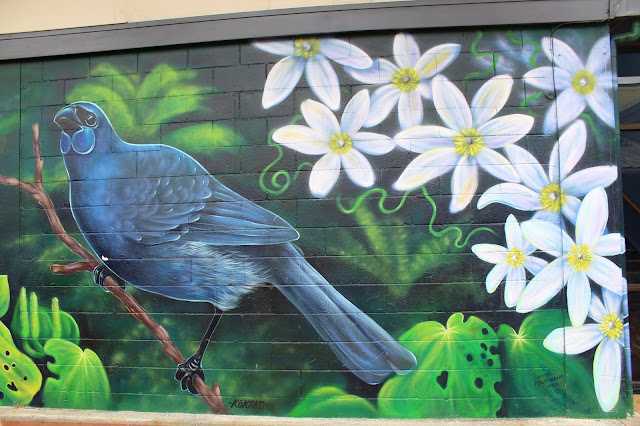
Kokako by Erika Pearce


 Another mural I spotted on the side of a building recently in Paihia. This one is also painted by artist Erika Peace (like the one I shared on the side of a cliff) and it's called "Kokako" as part of the Focus Paihia Project. "Kokako" is the maori word for our Blue Wattled Crow, a species which was endangered but is now slowly recovering. These birds live in various parts of the north island of NZ such as Northland, Waikato, Bay of Plenty, Little Barrier, Tiritiri Matangi Islands etc, they have a blue grey body, a striking black mask over their face and blue wattles under the throat.


Also on the mural is a depicting of fish which live in the Bay of Islands along with red Pohutukawa flowers and green Kawakawa leaves.

Linking up with Mural Monday.

Saturday, 26 October 2019

Lots of people - no thanks!


A couple of weeks ago we stopped in Warkworth, a town about 45 minutes away. We really didn't want to go there as they had an annual event going called the "Kowhai Festival". Kowhai is one of our country's trees. It flowers in Spring and has lovely yellow blooms that attract the Tui.


I don't do large groups of people, I just don't - I 'd rather be with maybe 2 or 3 people at the most, I just find it too crowded in these sorts of situations. The main streets were closed off and it was hard to find parking.


The roads are full of different stalls - anything like real estate, political parties, crafts, foods, charities, clothing etc.  Apparently it's been running every year in October since 1970 and has been extremely popular even since.


Warkworth is one of those places that has grown immensely, 20-30 years ago it was a small country town - now it has branched out with those moving out of Auckland.

Anyway, after doing what we had to do we were glad to get out of there and head home.

Monday, 14 October 2019

Omaha Beach Bird Sanctuary


Here in NZ we have lots of birds that are critically endangered. Some of them live here at Omaha Beach, a small seaside town about 40 minutes south of us. The town itself is quite elite with all sorts of rich and richer people not only living in opulent houses but lots of holiday places too. I would estimate most of the properties as being worth well over $800,000 NZD.


Anyway to get through this part of the beach we had to enter a cage like area with sliding doors that automatically shut. Although there are rocks separating the main beach from the sanctuary there is still a a fenced off section where the birds breed. I think this is a great idea as where we live we have similar endangered birds that breed and we don't have fences only taped off areas with small signs that sadly people tend to ignore this anyway.


You may be able to see the poles in this photo, these have string linking them together as this is where the birds are breeding and feed in the estuary at low tide.


On the main part of the beach these Oyster Catchers were standing in the sunshine. Their conservation state is listed as "recovering". They are usually black with an orange bill and reached low numbers until they were protected in 1922, since then their numbers have slowly grown. They can live up to about 30 years old.


If you can see this little guy he's a Dotteril, their status is listed as "endangered" but they are slowly recovering. A total of 2075 northern NZ ones were counted in the 2011 breeding census. Southern Dotterils reached a low of 62 birds in 1992 but they have responded well to management and the post population fluctuated between 240 and 290 birds from 2005 to 2013. Since then there has been another decline and in 2015 there were fewer than 200 birds.


These ones are Eastern bar tailed Godwits and they fly long distances breeding in Alaska then fly to NZ staying over Summer and feeding on the flats from September until March. They are also protected but they are classed as "declining".

Sadly most people care about conservation here but we still get those who just don't care. There is suppose to be no vehicles, horses, cats, dogs, ferrets, stoats, rats and mice but people still drive in places like this, ride their horses and take their dogs near the birds and their nests.

Linking up with Our World Tuesday and My Corner of the World.

Monday, 26 August 2019

Just for the Tuis


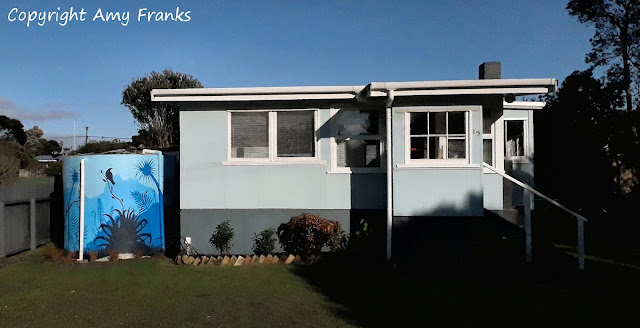
On each of my morning walks around town this week I've seen something interesting. This particular day I was walking past one of the many tiny holiday homes down one of the side streets and spotted this water tank cheerfully decorated in shades of blue. This one has been painted with illustrations of a Tui sitting on what looks to be the flowers of a native flax bush.

Here in Mangawhai and in other small towns sometimes the houses can either be connected to town supply water or they will have 10,000 ltr water tanks so when it rains the water goes directly inside off the roof - usually there is a filter between the tank and the house so that it's safe to drink.

Linking up with Mural Monday and Our World Tuesday.

New blog

 Please join me at my new blog which is at amypie71.blog. I'm still making a few tweaks to it here and there, please change your link fo...