Showing posts with label far north history. Show all posts

Saturday, 22 April 2023

St Barnabas Anglican Church, Peria

There are little old churches like this dotted all over the country. This one in Peria is St Barbabus church and is about 30 minutes from Mangonui. It is a category 2 on the historic places trust list and was built by the local community for the Reverend Renata Tangata who was ordained at St Paul's Cathedral in Auckland in 1867. 


By 1912 the church had become too small for the growing congregation and a new one was built to replace it which was dedicated as St Barnabas and opened by Bishop Crossley on March 26 1912 - this is the church that is there today. Information by Stuart Park - thank you.

Linking up with Weekend Reflections and the Weekend Roundup.

Thursday, 29 July 2021

The Taipa Bridge


 In 2019 a new modern updated bridge opened in Taipa. It is 107 metres long with 2 lanes for traffic and a 2.5 metre walking and cycle track. The new bridge’s most striking features are the waka tauihu (prow) and taurapa (stern) panels of a seafaring waka adorning each end. These acknowledge Taipā as one of the first landing places in New Zealand of the Polynesian explorer Kupe.

The waka hourua (a traditional double hulled sailing canoe) design and the pou whenua were the result of extensive collaboration between Waka Kotahi and the local hapū representatives of Ngāti Kahu. 

The close relationship with Ngāti Kahu also saw the relocation of a monument commemorating local fallen soldiers from the shop carpark to a more prominent location near the bridge.

This is the old Taipa bridge built in 1899. As the years have gone by this bridge was eventually unable to cope with the growing traffic volumes and and safety requirements of locals and tourists as they visit the local popular fishing spots. 

I actually found this video on youtube of the progress of the new bridge so it'll show you the Taipa area.

Linking up with Skywatch Friday.

Tuesday, 18 May 2021

Pompallier Mission House


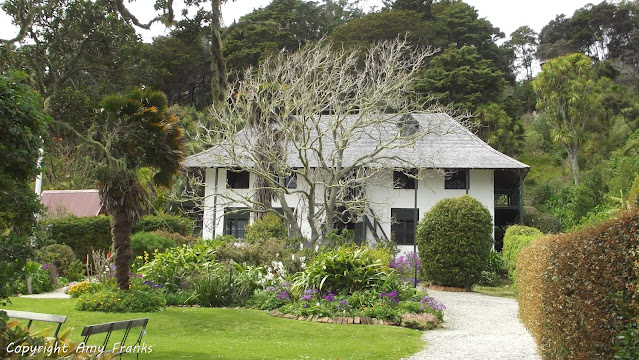
We were over in Russell last week on B's day off hoping to do a tour of the Pompallier Mission House but alas we were a bit late for the tour. History about this place is:  Built in 1842 it housed a printery where church texts were translated from Latin to te reo Māori, then printed and bound.  The property is just five minutes’ walk from the wharf at Russell, formerly known as Kororareka and infamous as the ‘hell-hole of the Pacific’ for its drunken and raucous behaviour. It was against this colourful backdrop that a group of French Marist Brothers – including Jean Baptiste Pompallier, after whom the property is named – arrived to set up a Catholic Mission in the settlement.

Unfortunately we were a bit late by the time we got there and B had an appointment that afternoon so it will have to wait until another time.


It looks very different to how it looks today (top photo) compared to this one taken in 1967. Edited to add: After searching for more information on the property I've found that the outside decking and rails seems to be removed because of structural issues the house has had over the years. 

Linking up with Our World Tuesday, Through my lens, Tuesday Treasures, Tuesday Travel, My corner of the world, Wordless Wednesday.

Sunday, 1 March 2020

We have a property!


We heard yesterday that we have finally scored a property so we should be moving by the end of March - it's a big relief and we are looking forward to starting again.  Here's a piece of Kerikeri history...it's what remains of the old hydro-electric station which began to produce power to 17 customers on 11 July 1930 and it is stuck in the middle of the Rainbow Falls river walk.

A Mr George Alderton with a land developer and some of his customers were British civil servants that were wanting to settle in town. Alot of them were use to having a privileged life along with servants and maids etc, the wives were not impressed at having to do the manual work themselves which is why having electricity would be essential.  George set up his company so the settler's wives would be happy and want to buy the land.


He then employed Lloyd Mandeno to investigate the potential of a hydro station on the Kerikeri River. He said that it should supply at least 300 horsepower but because of low seasonal flooding the water should be diverted from the Puketotara River.

At the end of 1929 George Alderton's company began constructing the dam as well as the open water race for water diverted from the 2 rivers and in 1930 the power was turned on.  The surviving machinery of the powerhouse has been restored (above) and placed where it originally was so visitors can walk along the track and see inside.

New blog

 Please join me at my new blog which is at amypie71.blog . I'm still making a few tweaks to it here and there, please change your link f...