Showing posts with label colonialism. Show all posts

Thursday, 7 January 2021

Okaihau settlers memorial 1868


During Winter last year after we came out of our national lockdown before I started working I visited the nearby town of Okaihau. A tiny settlement, the name of "Okaihau" means "place of feast of the winds" and at the time of the 2018 census the population was 1,236 people. 

This memorial in front of the rugby club commemorates the first settlers to the area who arrived in 1868 from Canada.  


Linking up with Skywatch Friday.

Thursday, 2 July 2020

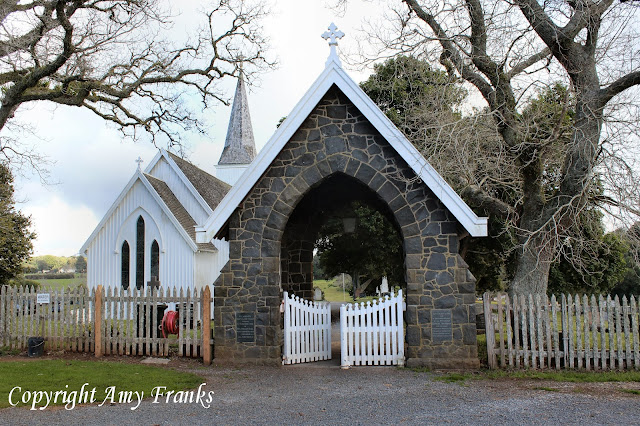
The Waimate North Lych Gate


I was out again at the Waimate North Mission Station yesterday as it's one of my favourite historical spots in the far north.  It was a very dreary Winter's day so I spent most of the time trying to dodge the raindrops while the sun was poking it's head out hence the overcast clouds in the photo above. There is a missionary house not far off on the other side of the driveway but for this post I'd like to focus on this entranceway to the church and cemetery.


According to my research the church itself was built in 1831 but this gate was built just under 100 years later in 1929 to mark the centenary of the settlement. A tablet was also placed inside the church in commemoration of the early missionaries to the area.  Inside on the walls of the gate are plaques in honour of fallen soldiers from the area who fought in the Battle of Ohaeawai in 1845. A church service and communion were held in the open air, the unveiling in the afternoon and a Maori powhiri (welcome) afterwards. In amongst the invited guests was Bishop Bennett (the first Maori Bishop) along with 26 clergy (17 of them Maori).


There were 2 speakers on the day, Mr E.A. Ransom (Minister of Public Works) who said "the time has come for the government to recognize a greater responsibility to the Maori people in regard to the occupation of their lands. And the honourable Joseph Coates who was the prime minister from 1925 to 1928 said "there should not be differentiation between the two races. The Maori should be given the same chances as the European people" and how his father had impressed upon him that he and his fellow settlers would have starved in the early days if it had not been for the generosity of the Maori people.

To me those words should still be considered today.  Hope you're staying safe where you are. Kia kaha.

Linking up with Skywatch Friday.

Tuesday, 16 June 2020

St Francis de Sales and All Saints Church


This is one place that's kinda special to me because of family connections. The St Francis de Sales and All Saints Church in Devonport, Auckland looks like one grand austere old lady.  Between 1890 and 1900 the Catholic population in town doubled and the first church on this site was a former mortuary chapel barged across the Auckland Harbour from the historical Symonds Street Cemetery to be resited here in 1893. This particular suburb was first settled by colonists in 1840 and is one of the first colonial settlements in Auckland and the first on the North Shore.


St Leo's school opened across the road in 1893 and by 1904 the church was enlarged for 200 parishioners. Father Michael Furlong who was the parish priest from 1905 to 1962 sold his own property to finance the current church, above which was built in 1919. 


My mum on the right with her twin on their confirmation day in the 1950s.

Interestingly enough my mother and her siblings were raised in Devonport and attended St Leo's school and this church as they were growing up, in fact when my grandmother passed away in 1996 her funeral was held here because they were all Catholics until the last 5 years of her life when she became a Christian.  Mum has said she remembers the nuns at school being very strict and not very kind to the children.

Linking up with Our World Tuesday and My Corner of the World.

Thursday, 6 February 2020

Te Tiriti o Waitangi


Today for us is national Waitangi Day which remembers the day the treaty was signed between the Europeans and the Maoris.

This marae located in Paihia was opened in 1922 replacing the original 1881 building, I'm not sure what happened to the earlier one. The land next to it was where the Declaration of Independence of New Zealand (treaty) was signed on 28 October 1835. 5 years later 300 more chiefs sat on the same spot to debate the treaty and signed it on 6 February 1840 at the home of British immigrant James Busby now known as the Waitangi Trust including the museum.

When I was going through the public school system in the 1970s and 1980s I remember being taught the basics of the treaty but when we visited this spot and the museum last Spring it was a truly eye opening experience. We walked out of there feeling quite humble - if you haven't visited the museum I urge you to as it really is well worth it. This year we are very thankful that NZ is the country it is today, we still have many improvements to make in the process of being more accepting of each other but it's good to be a Kiwi.

Linking up with Skywatch Friday.

Saturday, 2 November 2019

The old Grafton Bridge


How did your Halloween go this week? It came and went for us, we had a few groups of children knocking on our door and we already had a bowl of sweets ready to give out but apart from that it was pretty quiet.

Anyway earlier this week we traveled to Auckland to pick up the other half's step daughter from the airport. On the way we explored parts of the city - now I grew up in Auckland and worked in the central city for many years so sometimes I miss it.

This iconic structure named the Grafton Bridge is on the outer fringe and opened in 1910. It links up Grafton Gully to Karangahape Road, Auckland Hospital and the Auckland Domain. At the time it was built it was the largest concrete bridge arch in the world. Originally the first bridge built was made of wood at 360 feet long and 85 feet high - this one was built in 1885 but as population grew people voiced their opinions about the safety of the structure.

In 1907 the Auckland City Council took tenders to build the new concrete bridge (still there today) which measures 296 metres long with a central span of 320 feet, rising 84 feet  with a height of 142 feet off the valley floor.

In recent years the wave shaped like cover was put over both sides to prevent people jumping over onto the busy motorway below. Underneath the bridge exists the Symonds Street cemetery, one of the oldest places in NZ which houses the remains of mostly early settlers in the 1800s.

(photo from Heritage.org.nz)

These days this part of the city houses mostly University students and only a handful of the old colonial properties still exist. 

Sunday, 20 October 2019

Waipu Winner!


I think this is one of the most interesting murals I've seen so far. This one in Waipu Cove painted by Daniel Mills is geared towards the history of the town. Apparently the artist took about 3 weeks to research and was painted in 2007 yet still looks almost new.

Waipu is one of those places in NZ that was settled by Scottish immigrants about 150 years ago and includes a portrait of Reverend Norman McLeod, includes Scottish tartan how the old stores would've looked.


The mural was designed with input from the Waipu Museum and apparently school groups are seen here using the art for history lessons.

Linking up with Mural Monday and Our World Tuesday.

Tuesday, 18 June 2019

St Clement's Anglican Church


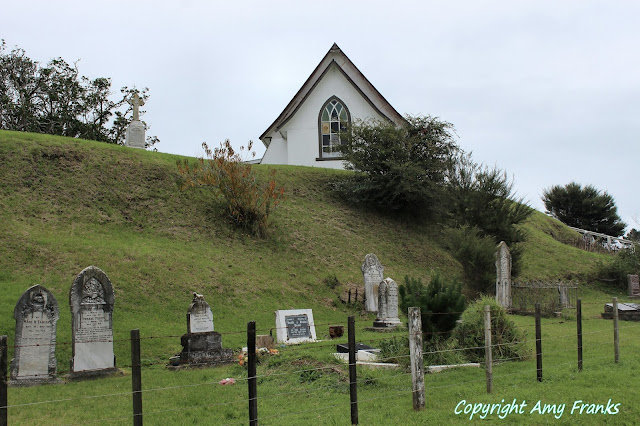
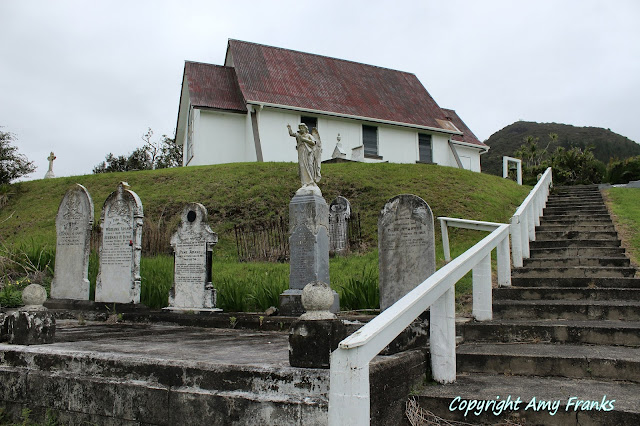
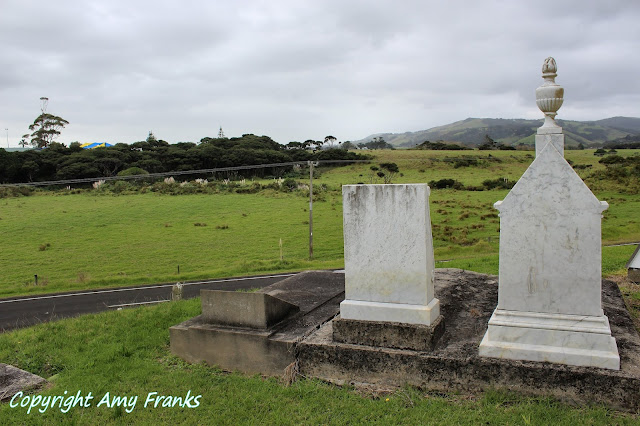
Nestled on a small hill just around the corner from Ahipara township and bay is this little wee gem. St Clement's Anglican Church and cemetery dates back to around 1873 and was named "Pukemiro" after the hill that is stands on.


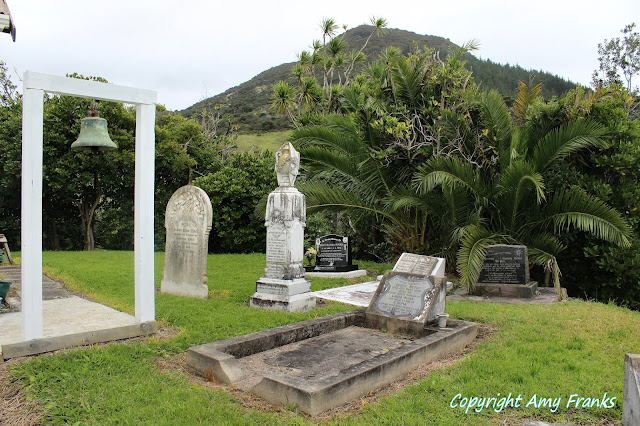
As per an old Maori story this area was chosen as a sacred burial spot for Poroa who was the Chief of Te Rawara - he lived here when times were peaceful. Most of the graves are from the 1800s with a few of them surrounded by old iron fencing.


Inside everything looks quite tidy, humble and well looked after. The church itself was built by local Maoris named Inoka Tutangiora, Rapata Wharawhara and Kihirini Te Morenga under the guidance of Richard Matthews who was the son of Joseph Matthews (part of the Missionary Society).


The view from the top steps next to the church looks out over miles of farmland. In 2012 restoration committee of the church were looking for funding to restore the church, I'd say since then alot of work has been done quite tastefully. After sharing these photos on Facebook I had a few people tell me their Tupuna (ancestors) were buried there.

Linking up with Our World Tuesday and My corner of the world.

Monday, 15 April 2019

Visit to Ruapekapeka Pa


A couple of weeks ago B and I wanted to go exploring but didn't want to travel far so we ended up at Ruapekapeka Pa just outside of Kawakawa, about 30 minutes away from home.


This area is one of the largest most complex pa sites that was designed to counter the cannons of the British Forces in the last battle of the Flagstaff War by the Ngapuhi lead by Hone Heke.


The new British governor failed to end the war by negotiations so the Colonial forces lead by Colonel Despard assembled 1,168 men in the Bay of Islands to deal with the Maori warriors. They began a 2 week advance over 12 km to bring artillery to the Pa.


The siege continued for 2 weeks then in the morning of 11 January 1846 a William Walker Turau discovered that the pa appeared to be abandoned. A small group of British forces entered the pa and found it almost empty. The remaining Maori left tried to re-enter from the back entrance but withdrew after a 4 hour gunfight.


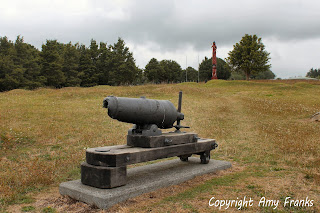
One of the entrances to a tunnel has been fenced off here so people don't fall in. The maori had a deck cannon (used for a ship) and a field gun. It was rendered useless though after it was hit 3 times and due to a limited supply of gunpowder the guns weren't able to be used much.


The pa was named Ruapekapeka (meaning bats nests) because of the tunnels and dugouts that still exist today. The caves underground could accommodate 15-20 warriors that had circular entrances at the top.


Later on after examining the Pa site it was found that it had been very well designed and strongly built. Reasons as to why the Maori had abandoned the site and then tried to re-enter it have been debated over the years. People have suggested they were at church as many of them had converted to Christianity. Knowing that the British were also Christians they had not expected an attack on a Sunday.


One of the Maori customs was that where blood was spilt that place became Tapu meaning sacred so the Ngapuhi left the Pa and carried their dead back home.

Linking up with Our World Tuesday.

New blog

 Please join me at my new blog which is at amypie71.blog . I'm still making a few tweaks to it here and there, please change your link f...