Showing posts with label kawakawa. Show all posts

Thursday, 6 January 2022

Stop


I've seen a few streets around our region where certain roads have been painted in bright colours with words like "stop" and "give way" etc and I'm guessing the idea is for them to stand out to motorists so that they take more care while driving.  The guy on the motorbike was driving through Kawakawa last week - Summer is perfect for bike rides.

Linking up with Skywatch FridayAll Seasons and Tom's Signs.

Tuesday, 28 December 2021

Bay of Islands Vintage Railway


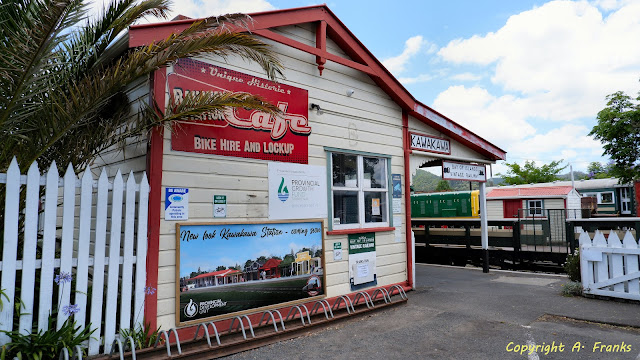
Earlier this week we were in Kawakawa where we decided to finally have a ride on the old vintage train at the railway station. 

The Bay of Islands Vintage Railway Trust is a heritage railway. It is the only working railway in New Zealand where the trains travel down a state highway and through the main street in town.


The railway is a volunteer run not for profit charity and the most northern railway in New Zealand. It is now celebrating 150 years of rail in the north island. This station was built in 1911 to replace the first one that was destroyed by fire and is recognized by the Rail Heritage Trust and Far North District Council as being of heritage significance.


This plaque says "To commemorate the centenary of this, the first use of railway transport on any part of the New Zealand Railways North Island System". Erected by The railway enthusiasts society (Inc) and unveiled on 2nd March 1968 by Hon JB Gordon, minister of railways.


We sat in the front carriage just behind the engine and this is our guide Dennis. He travels 5 days a week from his home in Whangarei to Kawakawa just so he can tell people all about the railway and trains. All of the people who work here are volunteers.


The above 3 photos show some of the scenery we drove past and through. 


At one point we had to stop and get off the train so that the main engine could turn around on the tracks and join up to the opposite end so we could go back the way we came.


And this is why. This is the Opua bridge - normally in the old days the train would've travelled across this all the way to Opua with coal and passengers but now the bridge is classed as being unsafe so the railway society has been trying for the last few years to get council approval and funding so that it can be fixed and made safe. The bridge is believed to be the oldest surviving curved rail bridge in the Southern Hemisphere.


The back carriage which then became the front on the way back.


This is the middle cart which connected the front and back carriages which was built in the 1950s.

And back through the main street of Kawakawa to the station again.

Linking up with Our World TuesdayThrough my lensTuesday TreasuresTravel TuesdayMy corner of the world and Wordless Wednesday.

Saturday, 28 August 2021

Inside a cafe


 I visited this cafe in Kawakawa about a month ago, sitting at a table with other people around me is a dream at the moment. Can't wait until Covid is over. This is for Tom's post for things beginning with "I" and Weekend Reflections.

Edited to add: we are still under lockdown here with a review due Monday night, this photo was taken beforehand.

Monday, 26 July 2021

Kawakawa vet mural


I spotted this mural on the side of the veterinary clinic in Kawakawa which was painted by kiwi artist Angela Newport who is originally from the Hokianga area but now lives in Canterbury. 

You can see more of her work on her website. Linking up with Mural Monday.

Thursday, 15 July 2021

The Lantern


I spent a few rainy hours in Kawakawa last week, not alot to do except browse through some of the shops. This bronze and glass sculpture on the main road caught my eye. It is the work of local artist and designer Richard Smart and its creation has involved more than 1500 hours of voluntary labour and commitment, it was designed to serve a functional purpose as a street light. The work was conceived in 2002 and has been driven behind the scenes jointly by the Kawakawa Community Trust and the Eastern Community Board.

Linking up with Skywatch Friday.

Saturday, 10 July 2021

Resting in Kawakawa


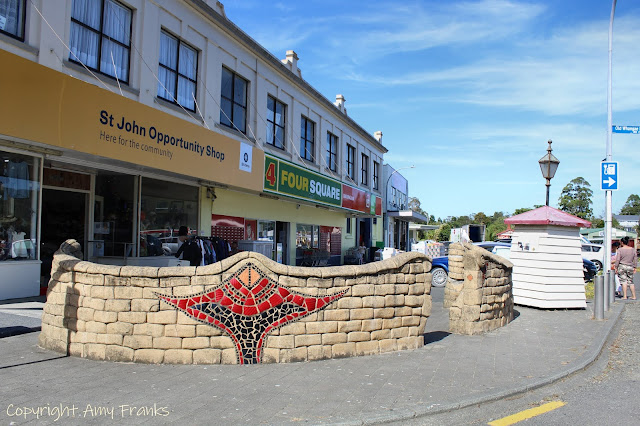
Photo taken of a lady having a rest on one of the mosaic brick seats along the main street with the Star Hotel and the old picture theatre in the background.

We have had a vet's visit this week with our manx "Bunny". Manx Cats don't have tails so their pelvic areas are usually deformed, 2nd time she's been blocked up but this time was also an abscess. With a small operation, anti-biotics and painkillers she's on the mend again...

Linking up with Weekend Reflections and The Weekend Roundup.

Monday, 5 July 2021

Eat fresh


 Another mural by Rodrigo Rozas - this one is on the side of a Japanese Sushi Shop in Kawakawa and was painted in February 2017. I don't know about you but I love sushi.

Linking up with Mural Monday.

Saturday, 15 May 2021

Kawakawa's street lamps


When I visited Kawakawa last Spring with my 2 adult children I noticed this street lamp sitting next to a mosaic brick wall near the end of town.  Apparently this one is a replica made by the Lions Club of the original 3 that use to sit along the main street in 1904. The acetylene gas was housed in the base and lit by the gas lighter. 

Linking up with  The Weekend Roundup and Weekend Reflections.

Monday, 22 February 2021

An underwater world


 I spotted these murals behind a gated area in Kawakawa last year, all I could see was an underwater world full of sea creatures and oceans, I have tried to find out who the artist is or what it was about but sadly there is nothing.  The area looks like it was once used for a specific purpose but what that was I have no idea...

Linking up with Mural Monday.

Saturday, 16 January 2021

Kawakawa Memorial Library


Last time just before Christmas when we were last in Kawakawa I spotted this tiny building because it kind of reminded me of an old small town jail.  But apparently it was built in 1921 by the people of Kawakawa in recognition of the lives lost in WW1.  It became a museum santioned by the RSA on Anzac Day 1988 following an exhibition of military photos and exhibits.

Linking up with Weekend Reflections and the Weekend Roundup.

Monday, 21 December 2020

Karetu School Mural


 I was in Kawakawa last week with my 2 adult children. In Summer if you don't get to your destination by at least 10am the temperature tends to rise to the point where you really don't want to be outside and most of the car parking is taken.  The 3 of us have very very fair skin so we have to wear sun scream whenever we can as we don't tan.

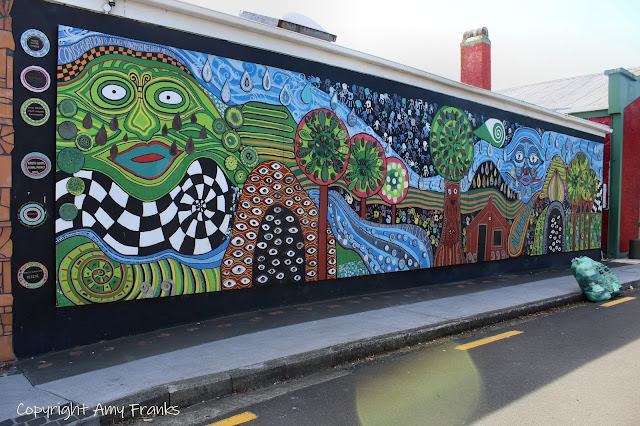
While they were off getting lunch I spotted this mural down an alleyway. I have to say I think it's really really clever artwork with all the different Maori imagery. Painted as part of Karetu School mural project in 2011 and measures 10 x 2 it apparently started off as a backdrop to a school play but ended up winning a "Keep NZ Beautiful" award before being scaled up then painted onto a treated plywood panel with ceramic, wood and metail details. 

It was blessed by Kaumatua (Maori elder) Bill Cherrington followed by a waiata (song) from the children, an explanation of how it came about and a haka.

Linking up with Mural Monday.

Tuesday, 14 July 2020

Monument to Hone Heke


Last week we drove out to Kaikohe on one of those very blustery cold winter days and boy was it cold, we basically dodged the hail.  Anyway we decided to stop off at the Monument to Hone Heke (not the Hone Heke who was involved in the treaty of Waitangi - that was his great uncle) who was born in Kaikohe in 1869 and a direct descendant of Rahiri. He was closely affiliated with Ngapuhi and 5 other tribes.


The family and tribal home was also in Kaikohe and he attended Oromahoe and Kawakawa native schools.  After showing early promise his family sent him to St Stephen's in Parnell, Auckland. After leaving school he worked for a while driving a bullock team operating between Kaikohe and Haruru possibly for his father who owned a team of 12 bullocks.


In his youth Hone Heke became aware of the aspirations of Maori for unity and independance, initially expressed by the 1835 Confederation of the United Tribes of New Zealand. These ideas were expanded during the 1880s into the Kotahitanga movement, whose aims included control by Maori over Maori lands and a degree of influence in local government.


At the 2nd session of the Maori parliament in 1893 Hone Heke may have asked permission to speak with the assembly but because of his age he was refused.  Apparently he then addressed the people outside and when 2 of the Maori elders heard him they were impressed by his knowledge so he was asked to address the whole assembly and the whole evening was given to him.


The impact he made lead to his gaining and influential position in the movement. He worked tirelessly, travelling the country to gain support. Te Kotahitanga became the strongest unifying force between Maori and in his early 20s he was elected to the House of Representatives then further elected chairman of the Council of Paramount Chiefs.

He proved himself as a gifted speaker with an ability to state a case clearly and in an orderly fashion. In 1894 he introduced the Native Rights Bill into the house which asked for a constitution for Maori  with protection of their rights under the Treaty of Waitangi.

Throughout his parliamentary career Heke remained an advocate of legislative reform to improve conditions for Maori people and his impact in the house was huge. In 1909 around the age of 40 sadly he passed away from tuberculosis and 2 years later this memorial stone was unveiled on Kaikohe Hill. More information here.

Linking up with Our World Tuesday and My Corner of the World.

Monday, 28 October 2019

The beauty of Kawakawa Balm


I have always loved this spot. At one part of our estuary there are various houses and holiday homes sited on top of the hills and cliff tops but this one particular one is right on the sand overlooking the water. Imagine waking up to the view of skies, clouds and waves? Bliss!

Anyway I've had a rather interesting experience this week. A few months ago the other half when we lived in Kerikeri fixed an internet problem on a property belonging to a lady named Rawi and her husband. Now this lady runs a business making natural products such as soap and skin creams etc.


(image from soapshack.org)

She gave him a small bag for me containing a bar of coloured soap and a small tub of Kawakawa balm. At the time I was really touched so I emailed her to say thank you. Anyway, after we moved back here to Mangawhai I put it in a drawer and forgot about it. Last week I had a graze and put some of the balm on, by the end of the day it was healed up.

FYI the Kawakawa tree is one of the native plants used in Maori traditional healing. Rongoa means "medicine" so the use of herbs and plants is well known. It also involves spiritual healing, massage and natural health. After the positive experience I had with this product I think I'll order some more once I run out.

Linking up with Our World Tuesday and My Corner of the World.

Tuesday, 13 August 2019

Bay of Islands Vintage Railway


It's not often we drive through Kawakawa, but last Saturday as we passed through I stopped to take some photos of the vintage trains. Apparently the railway first began in 1864 when coal was discovered then a tramway was built 4 years later.


The old tram tracks, which still run through the town were replaced by the railway line now there and the first rails were opened in 1877. The link through to Opua was finished in 1884 and led to Opua becoming a deep sea port.


Apparently the last train pulled out of Opua in 1977 and although there were attempts to continue the rail service the tracks fell into disrepair and after 122 years it was threatened with closure.


In 1984 the railway was granted a reprieve and the Bay of Islands railway was born. There is a steam train named "Gabriel" (the green one above) - this one is currently under restoration.


There is also a diesel red engine named "Dewey" built in 1896, a blue one named "Timmy" built in 1959 and a green one named "Charlie" made in 1967.


4 trains are scheduled to run every Friday, Saturday and Sunday all year and the railway is a non-profit. It also includes a cafe and giftshop people can buy souvenirs from.


And here is one of the trains making it's way on it's journey around Kawakawa.

Linking up with My Corner of the World.

Wednesday, 1 May 2019

St Andrews Church - Taumarere


Nearly halfway through my week and here's another historical church we found on our travels. St Andrews Anglican Church is in Taumarere, just out of Kawakawa and was was erected in Paihia in 1874.


We've been quite fortunate so far in that most of the churches we explored have had unlocked doors with signs welcoming people inside. This one in particular served all ethnicities of people mainly Maori but after the attendance numbers dropped it fell into disrepair. In 1904-ish a lay preacher named William Bedggood arrived in the area and began repairing the church. In 1926 it was moved by barge then transported by Bullocks to where it is today.

The inside of the church, in particular the carpet and atmosphere had a very 1950's/1960s feeling, I don't know whether it was the tablecloth or the mat but it was good to see that it's been kept so nicely.

Linking up with My Corner of the World.

Monday, 15 April 2019

Visit to Ruapekapeka Pa


A couple of weeks ago B and I wanted to go exploring but didn't want to travel far so we ended up at Ruapekapeka Pa just outside of Kawakawa, about 30 minutes away from home.


This area is one of the largest most complex pa sites that was designed to counter the cannons of the British Forces in the last battle of the Flagstaff War by the Ngapuhi lead by Hone Heke.


The new British governor failed to end the war by negotiations so the Colonial forces lead by Colonel Despard assembled 1,168 men in the Bay of Islands to deal with the Maori warriors. They began a 2 week advance over 12 km to bring artillery to the Pa.


The siege continued for 2 weeks then in the morning of 11 January 1846 a William Walker Turau discovered that the pa appeared to be abandoned. A small group of British forces entered the pa and found it almost empty. The remaining Maori left tried to re-enter from the back entrance but withdrew after a 4 hour gunfight.


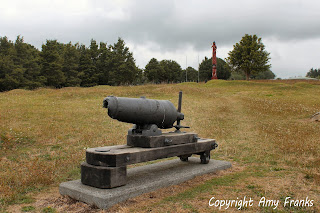
One of the entrances to a tunnel has been fenced off here so people don't fall in. The maori had a deck cannon (used for a ship) and a field gun. It was rendered useless though after it was hit 3 times and due to a limited supply of gunpowder the guns weren't able to be used much.


The pa was named Ruapekapeka (meaning bats nests) because of the tunnels and dugouts that still exist today. The caves underground could accommodate 15-20 warriors that had circular entrances at the top.


Later on after examining the Pa site it was found that it had been very well designed and strongly built. Reasons as to why the Maori had abandoned the site and then tried to re-enter it have been debated over the years. People have suggested they were at church as many of them had converted to Christianity. Knowing that the British were also Christians they had not expected an attack on a Sunday.


One of the Maori customs was that where blood was spilt that place became Tapu meaning sacred so the Ngapuhi left the Pa and carried their dead back home.

Linking up with Our World Tuesday.

Tuesday, 26 February 2019

Signs of Autumn at Kawakawa


Autumn skies and scenery at Kawakawa Bay where the tide was out. This lovely place is about 45 minutes south of Auckland central on the coast just before Orere Point.

You know Summer is on its way out when my sinuses and hayfever allergies start playing up...right about now.

Linking up with Our World Tuesday.

New blog

 Please join me at my new blog which is at amypie71.blog . I'm still making a few tweaks to it here and there, please change your link f...